
When it comes to measuring and reporting productivity, Canada’s public service is a sad example of concealment and false pretense. A problem culture that resists change, relishes detailed policies and procedures, and focuses on expanding bureaucracy instead of looking for ways to streamline and save money. An very insular organization of career public servants that lack accountability, do not value private sector experience and leadership, and do not embrace common sense improvement opportunities especially if they impact how things are done.
In this context, it is not surprising that the Canadian federal public service is unwilling to measure and report its productivity. The behavior of public servants mirrors that of elected government officials, most of whom are complacent (to avoid negative publicity at all costs), and in many cases downright ignorant, about Canada’s declining productivity at the macroeconomic level. Central bankers and renowned economists have repeatedly raised the alarm and issued warnings. Canada must address decades of declining productivity or face dire consequences. Anyone sugar coating the problem or sweeping it under the rug is totally dishonest about the situation.

What is productivity?
Productivity is a measure of outputs (goods and services produced) relative to inputs (resources consumed for producing the goods and services). The resources include labor-hours, materials, and assets such as computers, machinery, equipment, buildings, etc. The relation of outputs to inputs is normally expressed as a ratio of units or dollars. Examples of productivity measurements include the amount of services delivered per labor-hours, and the dollar value of total production versus total production costs. From a macroeconomic perspective, productivity is measured by comparing gross domestic product (GDP) with total hours worked. GDP is the total value of goods and services produced by a country, typically measured on an annual or quarterly basis.
Productivity is similar to efficiency, but has a broader meaning. For example, productivity can improve by upgrading or adding machinery. By contrast, efficiency refers to a ratio of outputs to inputs using the same inputs – in this example without upgrading or adding machinery. As such, efficiency is about getting more outputs from a given set of resources, while productivity includes altering the mix or amount of resources to achieve a better ratio of outputs to inputs.
Cost-effectiveness is a similar but slightly different concept. It is measured by comparing total costs to levels of activities, outputs, or any other type of achievement. Cost-effectiveness is normally measured as costs per unit. An organization improves cost-effectiveness by reducing its costs per unit over time. Effectiveness is the level at which an output or any other type of achievement such as a goal, strategy, objective, or desirable outcome is attained. For example, an organization may have a goal to improve customer satisfaction to a level of 95 percent or better. Effectiveness does not take into account the amount of resources used for achieving the target.
Productivity issues within government operations
The Canadian federal public service is unwilling to measure and report its productivity. Doing so would likely be very embarrassing given the ballooning size of the federal public service, which has grown by 43 percent in the past decade,1 compared with a population increase of 16 percent during the same period.2 Presumably, it took 43 percent more public servants to deliver a 16 percent increase in programs and services. A shocking statistic, if only it was accompanied by noticeable improvements in program and service delivery. Quite the opposite in reality.
During the past decade, Canadians witnessed spectacular program and service delivery failures, issues, delays, and cost overruns in many areas, including but not limited to: citizenship and immigration, bail reform, foreign interference, coast guard, call centers, access to information, passport processing, court system backlogs, affordable housing, public health, forest fire interventions, military equipment, defense procurement, arctic presence, housing of military personnel, services to veterans, management of real estate, border services, drug enforcement, money laundering, first nations health and living standards, benefits plan outsourcing, payroll processing errors and backlogs, etc. These failures, and many others reported by the Office of the Auditor General of Canada, are well publicized. Sadly, many more failures, issues, delays and cost overruns could be mentioned at provincial and municipal levels across Canada.
Declining productivity at the macroeconomic level
Canada’s real GDP per capita average growth is at its lowest point since the Great Depression,3 with an accelerating downward trend (Figure 1). Relative to OECD countries, Canada’s real GDP per capita average growth is sliding to the bottom, now tied with Japan, and only marginally ahead of lowest ranking Luxembourg and Mexico (Figure 2).
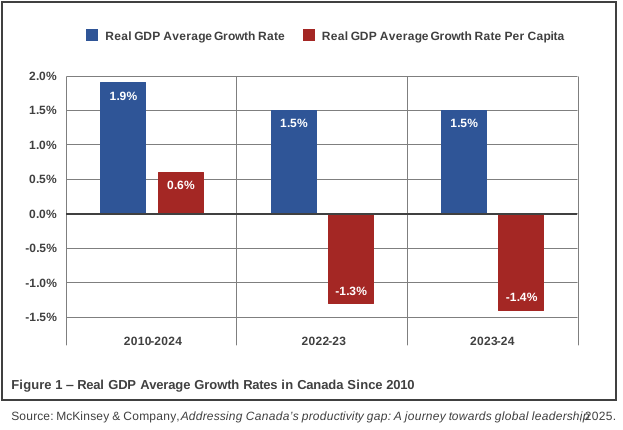

Canada has a widening prosperity gap with the United States. In 1982, Canada’s real GDP per capita was approximately 94% of the United States.4 By 2002, it was down to 82%, and by 2022 it was only 72%.5 During that 40-year period, the gap increased by almost 25%, representing a significant impoverishment of the Canadian economy relative to the United States. According to experts from McKinsey, the widening gap is “not a temporary shock.”6 It reflects decades of bad policy decisions and missed opportunities. They believe it is possible for Canada to reverse the trend, but doing so will require “unprecedented pace and bold action.”7 Impossible to achieve unless all levels of government (representing 40% of the Canadian economy based on spending), rapidly and keenly get on board with measuring, reporting and improving their productivity.
Several prominent central bankers and chief economists are sounding the alarm. Early in 2024, Carolyn Rogers, Senior Deputy Governor of the Bank of Canada issued a stark warning about Canada’s weak labor productivity and low levels of investment, calling the problem an emergency that makes it harder to control inflation and erodes living standards.8 “You’ve seen the signs that say ‘In emergency, break the glass,’ well it’s time to break the glass” Ms. Rogers was quoted as saying.9 Stephen Tapp, Chief Economist of the Canadian Chamber of Commerce added that “something needed to change to jumpstart economic growth” in Canada.10 Stephen Poloz, a former Bank of Canada Governor, also expressed concern. “We’ve been fundamentally weak [at raising productivity] in this country for 10 years” he was quoted as saying.11
Working group on public service productivity
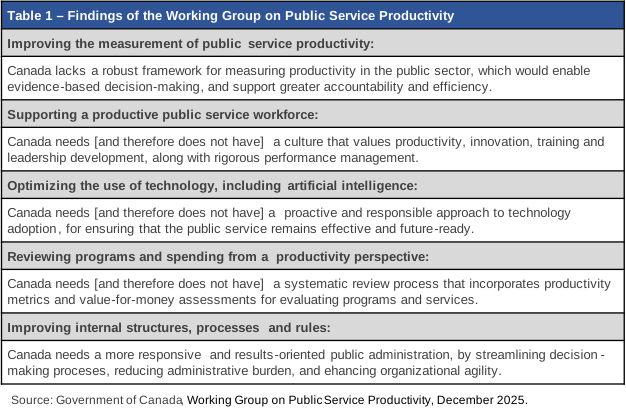
A Working Group on Public Service Productivity was appointed in the autumn of 2024, with a mandate to “examine productivity in Canada’s federal public service, and inform the government’s economic plan.”12 The working group was specifically asked to produce a report with “observations of the current status of productivity in the federal public service, the factors affecting public service productivity, and priorities for action.” The issues explored are the following:13
- “Improving the measurement of public service productivity”
- “Supporting a productive public service workforce”
- “Optimizing the use of technology, including artificial intelligence”
- “Reviewing programs and spending from a productivity perspective”
- “Improving internal structures, processes and rules”
The appointment of the working group preceded the government’s 2025 Speech From the Throne, and the Prime Minister’s Mandate Letter to federal departments and agencies, which recognized “the importance of improving productivity of the federal public service to achieve better results for Canadians.”14 Although the 2025 federal government budget set aside funds to try to improve Canada’s productivity at the macroeconomic level, it made no specific mention of public service productivity, other than an expenditure review and downsizing of the federal public service, to bring employee growth back in line with population growth (Figure 3). Curiously, the budget document made no reference to the Working Group on Public Service Productivity.15 A rather shady and furtive oversight, given priorities outlined in the Speech from the Throne and Mandate Letter.

Disturbing findings of the working group
In a report released by the government just before Christmas (evidently to limit media attention), the Working Group on Public Service Productivity indicates that “much could be done to improve productivity in the federal public service,” and proposed 19 recommendations for consideration. Table 1 summarizes the findings of the working group in relation to the issues explored.
Lame response from public service officials
The response from Treasury Board Secretariat (TBS), the central agency of federal government supposed to ensure that “tax dollars are spent wisely and effectively” demonstrates a total lack of enthusiasm for the working group recommendations. TBS argues that it is already doing certain things that “link” to the recommendations, and will “consider” other recommendations if funds are allocated for them in the budget. A false pretense for not taking action, because available resources could be reallocated and/or new resources could be sought. Not even a single pilot project proposed for measuring and reporting productivity for a government program or service. That is the measure of the response (prepared by public servants) to the working group recommendations.
Not surprisingly (from a public service that often resists change, transparency and accountability), the response completely ignores the most fundamental recommendations of the working group, namely to develop a productivity measurement framework, and to integrate the measurement of productivity to the existing process for evaluating programs and services. Figure 4 illustrates the missing link in the evaluation of programs and services delivered to Canadians. It should be noted that internal administrative / corporate services are never directly evaluated, leaving the federal public service bureaucracy immune from challenge to its operational performance.

Widespread criticism by well-informed experts
Critics are confused about why the government would assemble a working group, only to disregard much of its work. “If we’re not serious about measuring overall productivity, then why should we assume that productivity is going to improve?” said Stephen Tapp, Chief Economist at the Centre for the Study of Living Standards, and author of numerous articles on “slouching productivity in the public sector” and its effect on the economy.16 Many of his articles are published by the Macdonald-Laurier Institute, a “rigorously independent and non-partisan” public policy research organization.
Michael Wernick, former Clerk of the Privy Council (the most senior position in federal public service) said he was “disappointed by the government’s sidestepping of the recommendations on measuring productivity. (…) There are big parts of government where looking more closely at the relationship between inputs and outputs will uncover some really important issues” Mr. Wernick was quoted as saying.17 According to Randall Denley, well-known journalist and government critic, “the federal government’s limp response to measuring public service productivity – that they’re simply not going to do it – is deflating for those who imagined that Prime Minister Mark Carney would act like a noted economist. Instead, Mark Carney, the politician, has chosen to ignore his own government’s expert task force’s recommendations to measure productivity across the public sector.”18 A more than surprising turn of events given his Mandate Letter emphasizing public-sector productivity.
Truth be known – Shockingly poor performance
A TBS report issued in January 2025, indicates that only 52% of high volume federal government services met service standards during 2024-25, down from 55% the previous fiscal year, and well below a target of 80%. Moreover, only 38% of federal government computer system applications were assessed as “healthy,” slightly below a very low target of 40%.19 This means that highly-sought after services delivered to Canadians don’t meet service standards almost half the time, enabled by inadequate applications in more than sixty-percent of cases. The public service is well-aware of these day-to-day realities. It’s time for elected federal government officials to wake up, smell the coffee, and stop their make believe that Canada’s public service is so remarkable!
Where there’s a will, there’s a way
To all public service naysayers: please note that measuring public service productivity is possible. The United Kingdom and Australia are doing it. According to Stephen Tapp, “other countries such as the United Kingdom have done work to improve productivity measurement, particularly looking at outputs and outcomes.”20 David McLaughlin, Chief of Staff to a former Canadian Prime Minister, mentions that Australia “has had more openness to structural reform and public service reform, particularly around productivity. Australia has a productivity commission that, in part, holds inquiries and provides reports on government services. (…) It’s important to have organizational structures that drive the public service and say: this is what we need,” says Mr. McLaughlin.21
Simple solution: Accountability matters
An old adage commonly attributed to renowned management professor Peter Drucker, is that you can’t manage what you don’t measure. Another cardinal rule is that accountability matters. There will be no meaningful headway in public service productivity unless senior public servants are responsible and accountable for measuring, reporting and improving productivity – to the point where their bonuses, promotions and job security are on the line.
The approach to follow is quite simple: 1) consult with reputable governments that measure productivity; 2) establish a pilot project that offers a good, interesting case study; 3) measure and report the productivity of programs and services from that case study; 4) solicit feed-back from a panel of expert advisors; 5) fine tune everything based on the feed-back; 6) develop a measurement framework; 7) establish an independent oversight body that reports to Parliament; 8) develop a plan for rolling out productivity measurement and reporting across the public service; 9) educate public service managers on measuring and reporting productivity; 10) make senior public servants accountable for measuring, reporting and improving productivity; 11) verify the measurement and reporting; and most importantly 12) discipline those who resist or game the system. No rocket science or nuclear physics here – just common sense and basic management principles.
Addendum – Example of productivity issue encountered
FEBRUARY 2026 – I received a notice of assessment update from the Canada Revenue Agency (CRA) that an account balance is outstanding. The notice was dated January 30, 2026. The amount was already paid online mid-October 2025, using the CRA’s online payment application. The account number was entered as part of the payment process, and a payment confirmation was generated, which includes a confirmation number issued by the CRA. When I called the CRA for explanation, I first had to navigate through a web of confusing options and irrelevant recorded messages for more than 15 minutes before reaching the right destination. After an exhaustive authentication process, the person was unable to understand the problem, and put me on hold on three separate occasions while trying to figure it out and talk to CRA accounting… The whole conversation lasted more than 30 minutes. In the end, I was told that the payment was sitting in a “separate area of the accounting ledger, and had not yet been allocated to the account” – more than 3 months after it had been received. While keeping me on the phone, the person explained that she needed to type a request to CRA accounting (I could hear her typing over the phone), for the amount to be “moved to the account, applied against the balance, and for the interest penalty to be reversed.” She asked for my phone number, presumably for a call-back in case more explanations are required. Evidently, the CRA is receiving cash payments through its online payment application (which they want taxpayers to use), but those payments remain in limbo for several months (and possibly even longer if you don’t call them), while they continue to mail updated notices of assessments that include interest charges for late payments!! When I asked to speak with representatives of CRA accounting about this matter, I was told that I could not be transferred to them, and was offered more irrelevant technical explanations about CRA’s (very handraulic) accounting process and systems, as if those explanations were acceptable excuses that I should be satisfied with. No initiative to escalate the problem and have it fixed. How can a payment application be implemented, which does not automatically allocate payments received directly to the account for which a payment is made?? No wonder the federal government public service does not want to measure and report its productivity!!
Endnotes
__________________________
1 Matthew Lau, Public service ballooning — at your expense, (Ottawa Citizen, August 24, 2024).
2 Based on figures from Statistics Canada, available on the Internet.
3 Matthew Lau, Canadian governments spending their way into misery, (National Post, August 4, 2023.
4 Elaine Almeida, et.al., Addressing Canada’s productivity gap: A journey towards global leadership, (…).
5 Tom Blackwell, Productivity on the precipice, (Ottawa Citizen, April 15, 2025).
6 Elaine Almeida, Greg Kudar, Richard Luft, Rob Palter, and Zak Cutler, Addressing Canada’sproductivity gap: A journey towards global leadership, (McKinsey & Company, November 2025).
7 Elaine Almeida, et.al., Addressing Canada’s productivity gap: A journey towards global leadership, (…).
8 Mark Rendell, Canada’s weak productivity an emergency, poses inflation risks, BoC says, (Globe, March 27, 2024).
9 Naimul Karim, Progress on inflation prompts BOC rate cut, (Ottawa Citizen / Financial Post, June 6, 2024).
10 Naimul Karim, Progress on inflation prompts BOC rate cut, (Ottawa Citizen / Financial Post, June 6, 2024).
11 Tom Blackwell, Productivity on the precipice, (Ottawa Citizen, April 15, 2025).
12 Government of Canada, Working Group on Public Service Productivity: Overview, (December 2025).
13 Government of Canada, Working Group on Public Service Productivity: Overview, (December 2025).
14 Government of Canada, Working Group on Public Service Productivity: Treasury Board of Canada Secretariat response to the recommendations of the Working Group, (December 2025).
15 Government of Canada, Canada Strong, Budget 2025.
16 Matteo Cimellaro, Observers blast government refusal of using job metrics – Measuring productivity dismissed as not a priority at this moment, (Ottawa Citizen, December 27, 2025).
17 Matteo Cimellaro, Observers blast government refusal of using job metrics, Measuring productivity dismissed (…)
18 Randall Denley, How productive is the Canadian public service? We’ll never know, (Ottawa Citizen, January 8, 2026.
19 Treasury Board of Canada Secretariat, 2024–25 Departmental Results Report.
20 Matteo Cimellaro, Observers blast government refusal of using job metrics, Measuring productivity dismissed (…)
21 Matteo Cimellaro, Observers blast government refusal of using job metrics, Measuring productivity dismissed (…)