
There is widespread misunderstanding about “free trade” agreements in the media and general public. These agreements are in fact regulations that allow the exchange of selected goods and services, usually (but not necessarily) without tariffs. The agreements include many conditions, restrictions, limitations, and rules such as arbitration, renegotiation and opting out, all of which are meant to protect parties to the agreement. In reality, there is no such thing as free trade among nations, just various attempts (agreements) at fair trade. If there really was “free trade” there would not be the need for an agreement regulating trade in the first place. Anyone could export-import anything, without restrictions, irrespective of the consequences on domestic economies.
Whenever there is an agreement, it is common to see that the agreement proves less favorable to one party over the other. It is also common to see one party trying to take advantage of the other by exploiting loopholes or workarounds to the agreement. Some parties may even act fraudulently to circumvent the terms and conditions of the agreement. Finally, it is sometimes discovered that one party had a hidden agenda or questionable motives coming into the agreement. It would be very naïve to presume that all parties to an agreement will be ethical. Such is the nature of the world we live in. Not everyone has good intentions, and not everyone treats others fairly. The same problems found at the personal level, are just as present at the organizational and country levels.

Economic theory and false assumptions
Economists propose that the case for free trade is evident. They argue that free trade promotes market efficiencies, economic growth and prosperity, by lowering the cost of goods and services. Organizations realize economies of scale when they produce larger quantities for bigger markets, further driving down the cost of goods and services. The greater competition brought by free trade forces organizations to reduce prices for consumers, as small local organizations have to compete against global players with higher volumes and lower costs. Accordingly, free trade and globalization go hand in hand. Both should be actively (and blindly) promoted according to economic theory.
However, the reality is that not all nations are well-intended. Some have disingenuous agendas to undermine others and cannot be trusted. Free trade only makes sense in a world where conflicts and wars do not exist, and every nation is entirely committed and trustworthy to act fairly with others, and for the greater good. That is not the world we live in – not by a long shot. In reality, efficiency and economic growth are desirable, but resiliency and national security are paramount. Countries risk losing their sovereignty if they are overly dependent on others for critical items. They are equally at risk if their industries are depleted to the point where domestic demand for essential items cannot be met in times of conflict. Countries are also at risk if their economy is overly driven by services, too reliant on imports, or not sustainable because of trade imbalances. Economic theory is blind to resiliency and national security concerns. It rests on numerous false assumptions.
Growing trade imbalances and effects
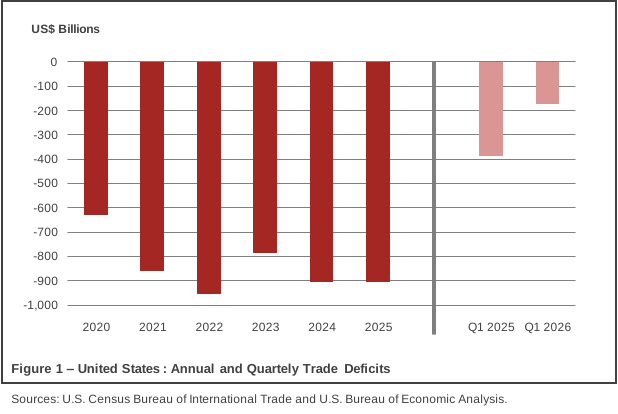
Significant trade imbalances among nations attest that free trade economic theory has not been applied with nearly enough caution, especially by the United States. It is not surprising that the most capitalist economy has embraced economic theory the most. But too much of a theoretically good thing is bad, especially when the downsides are significant in terms of diminished resilience and national security concerns, all driven by depleted industrial capacity. Since 2020, the United States experienced an increase of approximately 50% in its annual trade deficit (Figure 1), while trying to constructively engage its major trading partners toward achieving more balanced trade. Such polite diplomacy has in fact been going on for decades, evidently without success.
Polite diplomacy was attempted several times during both the Obama and Biden administrations, for the United States to address growing trade deficits with major trading partners such as China, the European Union, Canada and Mexico. Back in June 2016, during President Obama’s second term, U.S. Treasury Secretary Jacob Lew “warned China over unfair business practices” including bureaucratic complexities aimed at discouraging trade, and unfair competition from Chinese firms subsidized by the state.1 In July 2023, while President Biden was in office, U.S. Treasury Secretary Janet Yellen met with then Chinese Prime Minister Li Qiang to discuss China’s “unfair economic practices” and pledged that the United States would “hit back” at those practices.2 Although the trade imbalance narrowed in 2023, it bounced back during 2024 while Joe Biden was in office.
Shortly after taking office in January 2025, President Trump introduced the America First Trade Policy aimed at “boosting U.S. manufacturing, collecting tariff revenue, addressing unfair trade, and strengthening national security.”3 The tariffs imposed by the Trump administration, which began to take effect mostly after Q1 2025, prevented a record U.S. trade deficit for 2025. Although there is no credible trade deficit forecast for 2026, there is early indication that it will diminish substantially from 2025. For Q1 2026, the U.S. trade deficit dropped 55% compared with Q1 2025 (Figure 1), the only quarter during 2025 when very few Trump administration tariffs were in effect.
Unfair and unsustainable trade imbalances
Large trade imbalances are not sustainable for the long run. A country with a trade deficit has an outflow of money to other countries that it imports from. The outflow results in a weaker currency and higher debt levels. The only reason that the U.S. economy has been able to withstand huge trade deficits for so long is because the U.S. dollar is a reserve currency in demand for international payments. Any other currency would otherwise rapidly collapse. Rebalancing trade and reshoring manufacturing jobs to the United States are Trump administration priorities. No sensible country would ever accept huge trade deficits. The United States should not be an exception.
For all the criticism directed at the United States for imposing tariffs, no country running a large trade surplus with the United States has offered a plan for rebalancing trade and for moving toward fair trade. To my knowledge, there has only been retaliatory actions aimed at trying to maintain the status quo. In response, the Trump administration has doubled down on tariffs and threats, such as those targeting NATO members for insufficient defense spending, those targeting Canada and Mexico for ineffective border security, and those targeting China for dumping products at artificially low prices. These actions are regrettable but entirely predictable in a world where some try to take advantage of others, unwilling to accept that fair trade is the only kind of sustainable trade.
So many countries have benefited from running trade surpluses with the United States for so long, that they almost consider it an acquired right. To preserve their cosy way of life, they are unwilling to make fair-trade concessions. Those countries have built their economy under the assumption that the United States will continue to fund (indirectly) their economy and generous social policies by running a huge trade deficit, while also guaranteeing (indirectly) their defense and sovereignty by spending much more on national defense. This situation is grossly unfair to Americans footing the bill for military deterrence, and very selfish by allies taking advantage of it. Those same allies blaming the United States for wanting to redress trade imbalances, would not accept huge ongoing trade deficits for themselves because their country would likely become insolvent as a result.
Legal challenges and responses
In February 2026, the U.S. Supreme Court ruled that the Trump administration could not bypass Congress for imposing tariffs under the 1977 International Emergency Economic Powers Act (IEEPA). In response to this setback, the Trump administration imposed new tariffs under Section 122 of the U.S. Trade Act, which authorizes the President to impose import tariffs of up to 15% for a maximum of 150 days (unless extended by Congress) “to deal with large and serious United States balance-of-payment deficits” and/or “to cooperate with other countries in correcting an international balance-of-payments disequilibrium.”4 The tariffs imposed under Section 122 of the U.S. Trade Act are entirely legitimate under the circumstances of large ongoing U.S. trade deficits.
After the 150-day period, the Trump administration has stated that “those levies will be replaced with a longer-lasting tariff authority – Section 301 of the U.S. Trade Act.”5 Jamieson Greer, the U.S. Trade Representative, said “the United States was starting investigations under Section 301 of the Trade Act, citing what he called unfair practices such as running trade surpluses and building up too much industrial capacity.”6 Such practices can lead to permanent tariffs being imposed, provided that it is demonstrated that the practices are detrimental to the United States, and that the tariffs are proportionate to the harm done. It is widely understood that Section 301 tariffs would be on a much firmer legal ground than the tariffs previously imposed under the IEEPA.7
The investigations under Section 301 will specifically target “industrial overcapacity from export-reliant nations, which U.S. officials have said undermine U.S. producers by using subsidies to flood global markets with underpriced goods.”8 These investigations are expected to justify higher tariffs for several countries overreliant on exports, including China, Vietnam and Mexico. “Our view is that key trading partners have developed production capacity that is really untethered from domestic and global demand” said Mr. Greer.9 It is expected that the Section 301 investigations will be completed by the end of July 2026. Not surprisingly, China has been most strident in its opposition to the Section 301 investigations, arguing that the United States has no right to determine on its own if a trading partner has overcapacity.10 But not everyone sees it that way. “China is the primary source of the problem” said Tim Brightbill, an international trade attorney and co-chairman of the trade practice group at Wiley Rein, a leading law firm based in Washington, D.C.11
Reformers and disruptors – Who are they in reality?
The United States is at a crossroad and its allies need a very big wake-up call. Western allies see Donald Trump as a disruptive actor. But looking beyond the show of his rhetoric (mostly aimed at shaking things up in my view), one can see a reformer trying to reverse dangerous trends that his predecessors were unwilling to take on. They include NATO allies not living up to their defense commitments, and China not being forcefully confronted about its destabilizing industrial strategy, overcapacity and unfair trading practice. Taking on deeply enshrined trends requires heavy lifting. The kind of lifting that polite diplomacy has unfortunately not achieved in the past. Donald Trump is a controversial figure. But should he be viewed mostly as a disruptor, or much more like a reformer? An entirely valid question that requires looking at the facts with an objective mindset.
The Trump administration is drawing criticism for imposing tariffs to protect the U.S. economy, rebalance its trade deficits, and strengthen its resilience and national security. For Western allies dependent on exports to the United States, it is not very pleasant that a comfortable status quo is suddenly disturbed. Allies are forced to rebalance their trade, and redirect major spending to their national defense at the same time. A one-two punch wake-up call. These reforms are needed and long overdue. There is criticism and resistance to change, which is not surprising given the very comfortable (yet unfair and unsustainable) status quo taken for granted for so long. It is easy and safe to openly criticize Americans. Perhaps much easier and safer than criticizing China.
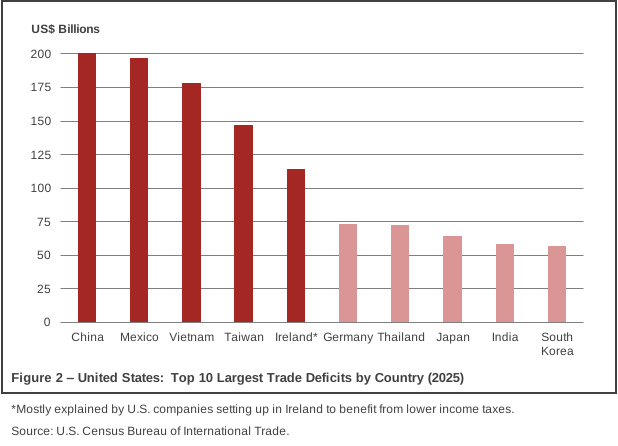
Despite all the criticism directed at the United States for wanting to reform trade, it should be abundantly clear that China is the real and most concerning disruptive actor. A disruptor unlike the world has ever seen. In 2025, China’s trade surplus with the rest of the world reached a record US$1.2 trillion. Although its shipments of goods to the United States fell 20% during 2025 compared with 2024,12 China still remained the country with the biggest trade surplus with the United States (Figure 2). Some of the tactics employed by China include funneling parts and goods to Mexico and Vietnam, which are assembled or repackaged for export to the United States. Several highly credible studies confirm that this practice has been going on for several years, including studies by the Harvard Business School, Stanford University, and Brookings Institute.13 The result is that the U.S. trade deficit with Mexico and Vietnam is now almost as big as the trade deficit with China.
It should be noted that the United States has imposed Section 301 tariffs against China for years (albeit insufficiently). These tariffs are seen by trade experts as a legally sound basis for Trump administration tariff policies.14 It should also be noted that during 2025, the United States reached what it called “agreements on reciprocal trade” with nearly 20 economies, including major trading partners such as the European Union, South Korea and Japan.15 These agreements force countries to open their markets more to American goods and products, and make investments in the United States in return for lower tariffs.16 These agreements demonstrate that the main objectives of the Trump administration tariffs are to reduce U.S. trade deficits with other countries.
The United States is negotiating with Mexico to rebalance trade. “The United States concluded discussions with the goals of reducing the trade deficit with Mexico and strengthening American supply chains” said the Office of the U.S. Trade Representative in a statement after meeting with Mexican officials.17 The Trade Representative added that the United States continues to emphasize the importance of ensuring that any agreement “benefits U.S. manufacturers, farmers, ranchers, workers, service suppliers, and businesses of all sizes, and of addressing free-riding from third countries.”18 Another clear evidence that the main goal of the Trump administration is to rebalance trade. If trade cannot be rebalanced with Mexico, tariffs will undoubtedly remain.
Disruptive and deceptive tactics by China
When it comes to economic policies, China is the real disruptor that the rest of the world needs to worry about. China employs many disruptive and deceptive tactics to grow its huge trade surplus with the rest of the world. These tactics include (but are not limited to) the following:
Manipulation of international organizations – During 2022, Canada’s foreign affairs minister stated that “China is an increasingly disruptive, global power looking to make the world more permissive to its interests.”19 China is manipulating and reshaping international organizations to legitimize its behavior, by ensuring that Chinese officials occupy several important and influential roles in key organizations such as the United Nations, the World Trade Organization, the World Bank, and the International Monetary Fund.20 Through active involvement in these organizations, China is seeking to redefine or reinterpret the rules of commerce to gain a greater advantage.21
Interference in foreign elections – In 2025, a public inquiry on foreign interference in Canadian elections concluded that “the People’s Republic of China (PRC) is the most active perpetrator of foreign interference targeting Canada’s democratic institutions. The PRC views Canada as a high-priority target.”22 Many other democracies including the United States, the United Kingdom, Australia, New Zealand, Taiwan, Indonesia, Malaysia, Cambodia, and the Philippines have flagged, identified or investigated election interference by China.23 China’s purpose is to help elect politicians who are favorable to its interests, or manipulable politicians using coercion, bribes, blackmail, etc.
Repression of Chinese diaspora – According to the 2025 Canadian public inquiry on foreign interference, “the People’s Republic of China (PRC) targets members of Chinese Canadian diaspora communities for the purposes of repression, influence, and forced return of targeted individuals to the PRC. It deploys a wide range of tradecraft to carry out its activities, one of which is to use a person’s family and friends living in the PRC as leverage against them. The PRC uses its diplomatic missions, PRC international students, community organizations and private individuals, among others, to carry out its transnational repression activities.”24 The Canadian Prime Minister in power at the time of the public inquiry said: “we have known for many years that there are consistent engagements by representatives of the Chinese government into Canadian communities and with local media, as well as reports of illicit Chinese police stations operating in the country.”25
Frustration and obstruction of trade arrangements – American and European companies have long been frustrated by China’s protectionist barriers and obstruction tactics aimed at frustrating trade arrangements. Such barriers include murky laws, inconsistent regulations, and bureaucratic complexity.26,27 Back in 2016, during President Obama’s second term, U.S. Treasury Secretary Jacob Lew cited several complaints by American companies regarding unfair business practices.28 At the time, European companies complained that China’s business environment is “increasingly hostile toward foreign companies, and perpetually tilted in favor of domestic players.”29
Unfair competition – Many Chinese competitors are “giant companies owned or subsidized by the state.”30 Studies indicate that “China spends much more in helping favored industries with state-directed funds, cheap loans and other incentives than other major economies.”31 In 2019, it was reported that China spent (relative to the size of its economy) about 4.5 times more than the United States, and 3 times more than France and Japan in subsidies.32,33 An updated analysis published in 2022 indicates that the scale of China’s industrial support could be as high as 10 to 12 times more than the United States.34 Scott Kennedy, an expert on China’s economy at the Center for Strategic and International Studies in Washington, D.C. said that “China is a large outlier. It spends an enormous amount on industrial policy and also uses more tools for such spending than anybody else.”35 The Biden administration confronted China about industrial policies and subsidies that give Chinese companies an edge over foreign rivals, evidently without much success.36
Insidious industrial strategy – China’s industrial strategy is an insidious economic weapon, increasingly used to subdue other countries by creating dependencies and making them vulnerable. The ultimate goal is to reduce or eliminate imports that make China susceptible to foreign influence, while increasing exports that make countries vulnerable to Chinese pressure.37 The end game is to achieve dominance by undermining the industrial strength of other countries, and making them highly dependent on Chinese manufacturing, supply chains, and cheap products.38 Economists have called on China to stimulate the country’s consumer spending, in order to mop up excess production and rebalance trade with other countries.39 Instead, China is doubling down on creating excess manufacturing capacity and dumping products on a greater scale.40 Chinese government tactics and subsidies “encourage” Chinese manufacturers to increase production despite weak domestic demand, forcing them to dump products at low prices in foreign markets.41 There is every reason to believe that Chinese manufacturers are coerced into production.
Weaponization of supply chains and trade – It is widely known that “China routinely retaliates against unfriendly governments by weaponizing its market – that is, shutting out its exports.”42 Examples include China shutting down exports of rare earths and minerals.43,44 In addition, China often blocks imports of goods to retaliate against countries that criticize its actions or impose anti-dumping tariffs. Examples include tariffs imposed by China on Canadian canola oil, pork and seafood in retaliation of Canadian tariffs on Chinese electric vehicles, steel and aluminum – all sold internationally at very low prices due to overcapacity and state subsidies. A study completed in 2026 for the U.S. Chamber of Commerce by the Rhodium Group, states that China “prioritizes chokepoint products that are critical to larger supply chains” in order to pressure other countries to accept its policies.45 When China decides to limit or ban exports of chokepoint products, entire supply chains are negatively affected. “As dependence on China increases, the capacity of foreign governments to mitigate that dependence diminishes” warns Rhodium.46 China’s actions call for a joint response by market-based economies to counter Chinese industrial policy says the Rhodium Group.47
European responses to China’s disruptive behaviors
The United States is not alone in denouncing disruptive economic behaviors by China. The European Union (EU) also worries about “the painful impact of the flood of cheap Chinese goods on local industries.”48 These worries were expressed very recently by the EU, despite already imposing tariffs on Chinese products, many in excess of 15%, and some 50% or higher.49 These tariffs aim to curb the EU’s huge trade deficit with China, despite the fact that the EU (unlike the United States) has a healthy overall trade surplus (US$152 billion in 2025). Evidently, the EU is worried that its trade surplus with the United States may vanish and no longer compensate for its trade deficit with China. Criticizing U.S. tariffs in this context is rather hypocritical to say the least.
It is fair to assume that the EU would impose even greater tariffs on China and its other trading partners if it ran a huge overall trade deficit like the United States. The political leaders of many countries blame the United States for imposing tariffs to rebalance trade, when they should instead look at themselves in the mirror, and wonder if they would accept a huge overall trade deficit, for how long, and how such a trade deficit would affect the economic well-being of their country. I am entirely convinced that they would act even more forcefully than the United States if they had the kind of overall unsustainable trade deficit that the United States is trying to redress.
The International Monetary Fund (IMF), responsible for promoting financial stability and cooperation across its 191 member countries (including China), is raising alarm in a manner consistent with the Trump administration investigations of industrial overcapacity. “In an unusually strongly worded rebuke, the IMF urged China to reorient its economy toward [domestic] consumption and scale back unwarranted industrial policy to mitigate international spillovers.”50 This additional example of polite (yet somewhat strongly worded) diplomacy is not swaying China whatsoever. China is in fact doubling down on its industrial strategy of overcapacity, excess production and dumping.
As Trump administration tariffs make exporting to the United States more difficult for Chinese producers, they are increasing exports to Europe and other markets.51 European politicians and business leaders are “fretting over their reliance on Chinese products and debating how to pull back.”52 Kaja Allas, Vice-President of the European Commission, recently suggested that “ending the continent’s dependence on China was like trying to cure a disease. Chemotherapy might be needed, and it will likely be painful” she was quoted as saying.53 The tone is “basically panic” said Jeromin Zettelmeyer, Director of a European research firm that specializes in economics.54
Similar to the United States, European leaders are looking at implementing a new “overcapacity instrument” aimed at limiting trade and imposing tariffs on countries that dump products. European leaders “hold the view that China’s global industrial dominance is a result of decades of government subsidies and non-reciprocal market access. (…) Five EU member states, [namely France, Spain, Italy, Lithuania and the Netherlands], called for the bloc’s executive arm to launch more probes into potentially unfair trading practices, be proactive when disputing alleged breaches at the World Trade Organization, amend existing rules to prevent businesses from circumventing them, and allocate more resources to tackle investigations into dumping and subsidies.”55
French President Emmanuel Macron requested the EU “to create measures that protect strategic industries, similar to the ones that the United States has and uses.”56 Spanish Prime Minister Pedro Sánchez during a recent visit to Beijing said that Europe needs China “to open up [its market] so that Europe does not have to close itself off.”57 In May 2026, the European Commission issued the following statement: “China is a critical partner and dialogue will continue. At the same time the current state of the trade and investment relationship is not sustainable. As economic and security interests become ever more intertwined, both dimensions will require a more robust and coherent response.”58 World leaders are expected to discuss trade imbalances at their next G7 meeting in France (June 15-17, 2026), and the ensuing European Council in Belgium (June 18-19, 2026).59 Analysts believe that “new safeguards could effectively serve as a sweeping new trade-defense mechanism against China, though policy measures are still under debate among EU members.”60 There is reason to believe that the debate may not be very long.
Efforts at trying to maintain the status quo
Not surprisingly, countries most dependent on exports to support their domestic economy are the most vocal and aggressive at trying to maintain their comfortable yet unsustainable status quo. Chief among them is China, which has disingenuous reasons for maintaining things the way they are, in order to gain greater influence by making other countries dependent and vulnerable. “China strongly opposes U.S. tariffs and will take countermeasures” said China’s Ministry of Commerce in a statement.61 A boldface threat issued by China, all while running a huge trade surplus with the United States, not offering a path toward balanced trade, but rather doubling down on trying to make its trade surplus even bigger. The Chinese Ministry of Commerce “accused Washington of undermining the rules-based multilateral trading system, disrupting the foundation of U.S.-China trade and economic cooperation, and destabilizing global supply chains.”62 No mention of China’s overcapacity, overreliance on exports, and the IMF warning that production must be scaled back.
Other countries overly dependent on exports for supporting their economy are also selfishly trying to maintain the status quo. “Big exporting countries – Germany, Japan, South Korea, Taiwan and others – have launched government spending programs that are largely tilted toward supporting manufacturers dependent on overseas markets. These [programs] aim to lower the cost of energy, transportation and capital, making it cheaper and more efficient for businesses to produce and export goods, partly offsetting the competitiveness hit from the Trump tariffs.”63 These countries are unwilling to accept a transition toward fair and balanced / sustainable trade, instead doubling down on subsidies to help their industries counter the effect of U.S. tariffs.64
The political leaders of these countries are misguided and shortsighted. They would rather enter into a trade war they cannot realistically win (because it benefits them politically in the short term), than work constructively with the United States to rebalance trade, and move toward fair and sustainable trade. Retaliation will only makes things worse. Refusing to do the right thing rarely leads to a positive outcome. It speaks volumes to the hypocrisy and selfishness of U.S. trade partners, and should only strengthen resolve by the United States to address its trade imbalances one way or the other (the easy way or the hard way). The United States has legitimate reasons for wanting to redress its trade deficit, and every reason to be impatient about it. One may not like the messenger, but the message is entirely valid and polite diplomacy has repeatedly failed in the past.
Implications of tariffs and retaliatory practices
The main implication of tariffs and retaliatory trade practices is a readjustment of trade that diminishes cross-country exports and imports, in favor of domestic sourcing and production. Economies overly dependent on exports typically experience higher unemployment, while those overreliant on imports experience inflation. The readjustment can be painful in the short term, leading most governments to expand fiscal and monetary policies in ways that stimulate investment and domestic consumption. Key implications include the reconfiguration of supply chains and reshoring of production, inflationary pressures, and the risks of rising unemployment and recession (especially at the beginning of the readjustment period).
Reconfiguration of supply chains and reshoring of production – A global business survey completed by McKinsey in November 2025 reveals that 82% of supply chains are affected by U.S. tariffs. Respondents indicate that they plan to reduce their supply chain dependence on China (38%), and shift a greater portion of their sourcing and supply chain presence to the United States during the next three years (43%).65 Not surprisingly, the anticipated outcome of tariff policies is for companies to source and produce where they sell as much as possible. An interesting side effect of these changes will be a reduction of fossil-fuel consumption from less transportation of materials, parts and finished goods back and forth across the globe.
Subdued inflationary pressures – Much has been said about the inflationary pressures of tariffs. However, there has not yet been a surge of inflation, unlike predictions from several analysts and commentors. That should not come as a surprise according to separate studies recently completed. Historically, inflation has been limited when new tariffs are applied, because pricing pressures are offset by falling demand. “Tariff shocks create economic uncertainty, weighing on business and consumers. As the economy slows, demand for goods and services falls, [creating a downward pressure on prices]” as reported by economists of the Federal Reserve Bank.66 Economists at Northwestern University arrive at a similar conclusion: “tariff increases were usually followed by slightly higher inflation. But the impact was small because rising import costs were counterbalanced by falling demand, as imports and exports dropped and manufacturing activity contracted.”67
Risks of rising unemployment and recession – Countries overly dependent on exports to sustain their economy evidently have a greater risk of unemployment and recession when other countries apply import tariffs. Such is the case for Canada, a country heavily reliant on exports to the United States for several industries. A study by the Royal Bank of Canada (RBC) published during 2025 predicted that U.S. tariffs “could tip Canada into a recession (…) and add two to three per cent to national unemployment rates. (…) While the precise impact depends on a variety of assumptions – including monetary and fiscal policy responses – this is a significant negative shock to Canadian growth and poses a serious risk of unemployment rate increases” commented RBC chief economists Frances Donald and Nathan Janzen.68 Incidentally, Canada is the first (and only) G7 country to recently announce a “technical recession” following Trump administration tariffs.
Greater protectionism in coming years
Globalization in its current form is not sustainable and will not continue. Countries have an opportunity to work constructively with the United States to rebalance trade, or take adversarial positions that will make the necessary readjustments even more painful. Unfortunately, the latter scenario may take hold for a while, until leaders mature and common sense prevails. Disingenuous geopolitical aspirations and unsustainable trade imbalances are forcing a rethink of globalization. Protectionism is necessary for greater resilience and national security. Additional forces will drive protectionism in coming years, including artificial intelligence and humanoid robotics. Many jobs will be impacted and unemployment may rise, leading governments to adopt trade protectionism. Countries willing to work constructively at implementing fair and balanced trade will have a much better chance of success, being recognized as ethical and trustworthy partners.
Dangers of pivoting toward China
Countries pivoting toward China are making a big mistake. Canada is perhaps the most obvious example. A country geographically, economically and security-dependent on the United States. Despite these realities, an “elbows up” campaign was clamored by Canadian politicians and pundits for pressuring against U.S. tariffs. The United States could not operate effectively without imports from Canada according Canadian politicians and political analysts. The American economy would be devasted with shortages and high inflation from imposing tariffs on Canadian products they said (foolishly making the case for greater protectionism by the United States to increase its industrial resilience and national security over a presumed dependence on Canada). All these hypocritical and self-serving “concerns” about the U.S. economy, but no mention of its huge trade deficits and their implications. In parallel to their rhetoric, Canadian politicians forming government began courting China for additional trade – their preferred approach over constructive dialogue aimed at rebalancing trade with the United States. In a show of arrogance, effrontery and false entitlement, many Canadians began booing the U.S. national anthem at hockey games in Canada. All very hypocritical, childish, naïve, foolish, cavalier and shortsighted. All Canadian? You be the judge.
It turns out that the “elbows up” campaign is very silent at this time. Canadian politicians are quietly realizing that their rhetoric is pie in the sky, and that the chickens are coming home to roost. Canada’s trade agreement with the United States is approaching a mandatory review by July 1, 2026, while doomsday predictions about a U.S. economy devasted by tariffs are not materializing. All of a sudden, Canadian politicians are trying to mend broken ties with the United States, after going as far as threatening to cut supplies of electricity to America. The theatrics of Canadian politicians are almost painful to watch, as the United States negotiates with Mexico while keeping Canada on the sidelines, and for good reason. Mexico took a more conciliatory approach early on when U.S. tariffs were imposed, discussing and trying to address issues more constructively than Canada.
Western allies trying to use China as leverage against the United States are playing a dangerous game. Similar to teasing your spouse or significant other to obtain concessions, by openly flirting with someone else right in front of them. Most people would not react very kindly to that situation. They may dump you much faster than you can blink. Once the trust is gone, it is very hard to build it back up. You may be left on your own, with a reputation forever tarnished as unworthy of a serious relationship. China will go along with the game, but is not blind to the situation. Very much like a new partner that does not actually love you, but is only trying to take advantage of you as much as possible, for its own benefits and aspirations. Not the kind of partner most people want.
Taiwan representatives to Canada put it bluntly. “China doesn’t hold the solution for Canada’s economic issues and isn’t a trustworthy partner. (…) China is not a market economy, with many restrictions on aspects of its own market. The contraction or expansion of their market is actually a result of political calculation. Those who buy from Canada are state-owned enterprise. It is not the consumers. The state can stop buying at any time [for political reasons or motivations].”69 Stephen Nagy, a professor of politics and international studies, warned that “China’s concessions [toward Canada] are part of an attempt to drive a wedge between Canada and the United States, noting how, when Beijing’s partners align with them politically, they’re rewarded. When they don’t, China turns to economic or political pressure. [Canada’s Prime Minister Mark Carney] needs to be prepared for China’s charm versus coercion approach. China may be letting Carney stick his toe in, but they’re going to cut it off as soon as they have a chance” Nagy warned.70
Those sentiments are echoed by retired general Wayne Eyre, former chief of the defense staff of Canada. In a speech delivered at the University of Ottawa, the former top general “warned against running into China’s arms as a move away from the United States.”71 Eyre said he “bristled” when Canada’s Liberal government launched a new “strategic partnership” with China to increase trade between the two countries. “We need to be wary of siding with China over the United States, as I believe that is the path to ruin” Eyre mentioned.72 While acknowledging that Canada’s relationship with the United States has changed, Eyre said it remains crucial. “We need to be careful about burning bridges with those [Americans] who are still friendly” Eyre said.73 “Having some trade [with China] is good, but doing it from a position where we’re not sacrificing our national interests and national values has got to be the way forward. Because if we go all in [siding with China], we’ll have our lunch eaten for us very, very fast” he further added.74
Canada’s federal government Indo-Pacific Strategy (published before Mark Carney became Prime Minister of Canada), referred to China as “an increasingly disruptive global power that disregards international rules and norms.”75 Canada is currently overlooking the threats posed by China, only because it wants more leverage against America. The Trump administration will pass, but China’s leadership and geopolitical ambitions will not. Western allies turning up their noses at the United States and pivoting toward China play a dangerous game at their own risks and perils. A different pivot toward fair, balanced and sustainable trade is the best way forward. Leaders of G7 nations should embrace this direction at their upcoming meetings in France, June 15-17, 2026.
Endnotes
__________________________
1 William Mauldin, China Business Climate Draws Fire From U.S. Treasury Secretary, (Wall Street Journal, June 16, 2016).
2 William Mauldin, China Business Climate Draws Fire From U.S. Treasury Secretary (…).
3 Jim Kilpatrick, et.al., Enhancing supply chain resilience in a new era of policy, (Deloitte Insights, April 2025).
4 United States Congress, Trade Act of 1974, Section 122.
5 Gavin Bade, Natalie Andrews, Trump Boosts New Global Tariff to 15% After Supreme Court Setback, (WSJ, Feb. 21, 2026).
6 Kim Mackrael, et.al., Allies to Trump: We’ll Live With Tariffs, Just Don’t Make Them Any Higher, (WSJ, March 14, 2026).
7 Gavin Bade, Trump Targets Industrial Subsidies and Forced Labor in Tariff Probes, (Wall Street Journal, March 11, 2026).
8 Gavin Bade, Trump Targets Industrial Subsidies and Forced Labor in Tariff Probes, (…).
9 Gavin Bade, Trump Targets Industrial Subsidies and Forced Labor in Tariff Probes, (…).
10 Hannah Miao, China’s Record Trade Surplus Defies Expectations for Tariff – Driven Slowdown, (WSJ, Jan. 13, 2026).
11 Kim Mackrael, et.al., Allies to Trump: We’ll Live With Tariffs, Just Don’t Make Them Any Higher, (…).
12 Hannah Miao, China’s Record Trade Surplus Defies Expectations for Tariff -Driven Slowdown, (…).
13 Ana Elena Azpúrua, Charting the US-China Trade War: What Does ‘Made in Vietnam’ Mean?, (Harvard Business School, October 24, 2024); Laura Alfaro and Davin Chor, Friendshoring? Nearshoring? Reshoring? How the U.S. Trade Relationship with China Is Evolving, (Stanford Center on China’s Economy and Institutions, 2023); Joshua P. Meltzer and Maricarmen Barron Esper, Is China circumventing US tariffs via Mexico and Canada?, (Brookings Institute, September 23, 2025).
14 Mark Rendell and Adrian Morrow, U.S. proposes new tariff over forced labour claims, (Globe and Mail June 4, 2026).
15 Mark Rendell and Adrian Morrow, U.S. proposes new tariff over forced labour claims, (…).
16 Mark Rendell and Adrian Morrow, U.S. proposes new tariff over forced labour claims, (…).
17 Tracy Moran, Trump Revives 51st State Barb Ahead of Talks, (Ottawa Citizen, June 3, 2026).
18 Tracy Moran, Trump Revives 51st State Barb Ahead of Talks, (…).
19 Anja Karadeglija, Canada will challenge ‘disruptive’ China, (National Post, November 10, 2022).
20 Akshay Singh, China’s plans to reshape the world, (National Post, June 13, 2022).
21 Paul Vieira, Canada Calls China Disruptive Global Actor, (Wall Street Journal, November 27, 2022).
22 Marie-Josée Hogue, Public Inquiry Into Foreign Interference in Federal Electoral Processes and Democratic Institutions, (Volume 1, Report Summary, Government of Canada, January 28, 2025), p.39.
23 Google AI Search Results, Developed by Google AI using multiple source documents (June 5, 2026).
24 Marie-Josée Hogue, Public Inquiry Into Foreign Interference in Federal Electoral Processes (…), p.98.
25 Paul Vieira, Canada Calls China Disruptive Global Actor, (…).
26 Laurie Burkitt, American Companies Say Doing Business in China is Getting Tougher, (WSJ, January 19, 2016).
27 William Mauldin, China Business Climate Draws Fire From U.S. Treasury Secretary (…).
28 William Mauldin, China Business Climate Draws Fire From U.S. Treasury Secretary (…).
29 Mark Magnier, European Firms Find ‘Increasingly Hostile’ Environment in China, (Wall Street Journal, June 6, 2016).
30 William Mauldin, China Business Climate Draws Fire From U.S. Treasury Secretary (…).
31 Lingling Wei, China Spends Far More Than Others to Help Favored Industries, Report Finds, (WSJ, May 23, 2022).
32 Lingling Wei, China Spends Far More Than Others to Help Favored Industries, Report Finds, (…).
33 Jason Douglas and Clarence Leong, The U.S. Has Been Spending Billions to Revive Manufacturing. But China is in Another League (Wall Street Journal, August 3, 2024).
34 Jason Douglas and Clarence Leong, The U.S. Has Been Spending Billions to Revive Manufacturing (…).
35 Lingling Wei, China Spends Far More Than Others to Help Favored Industries, Report Finds, (…).
36 Lingling Wei, China Spends Far More Than Others to Help Favored Industries, Report Finds, (…).
37 Greg Ip, Beijing’s ‘Industrial Policy of Everything’ Leaves Rest of the World in the Dust, (Wall Street Journal, May 15, 2026).
38 Lingling Wei, Xi Jinping Is Now the World Leader He Wanted to Be, but It Has Come at a Cost, (WSJ, May 18, 2026).\
39 Stella Yifan Xie, Tom Fairless, China is Making Too Much Stuff – and Other Countries are Worried (WSJ, Nov. 10, 2023).
40 Stella Yifan Xie, Tom Fairless, China is Making Too Much Stuff – and Other Countries are Worried (…).\
41 Laurie Burkitt, American Companies Say Doing Business in China is Getting Tougher, (WSJ, January 19, 2016).
42 Greg Ip, Beijing’s ‘Industrial Policy of Everything’ Leaves Rest of the World in the Dust, (…).
43 Greg Ip, Beijing’s ‘Industrial Policy of Everything’ Leaves Rest of the World in the Dust, (…).
44 Jeanna Smialek, Alexandra Stevenson, Europe edges closer to a trade war with China, (Globe and Mail, May 30, 2026).
45 Greg Ip, Beijing’s ‘Industrial Policy of Everything’ Leaves Rest of the World in the Dust, (…).
46 Greg Ip, Beijing’s ‘Industrial Policy of Everything’ Leaves Rest of the World in the Dust, (…).
47 Greg Ip, Beijing’s ‘Industrial Policy of Everything’ Leaves Rest of the World in the Dust, (…).
48 Hannah Miao, China’s Record Trade Surplus Defies Expectations for Tariff -Driven Slowdown, (…).
49 World Integrated Trade Solutions, European Union tariffs on China, (Year: 2022).
50 Tom Fairless and Gavin Bade, Why Tariffs Aren’t Shrinking the U.S. Trade Deficit, (WSJ, February 23, 2026).
51 Jeanna Smialek and Alexandra Stevenson, Europe edges closer to a trade war with China, (…).
52 Jeanna Smialek and Alexandra Stevenson, Europe edges closer to a trade war with China, (…).
53 Jeanna Smialek and Alexandra Stevenson, Europe edges closer to a trade war with China, (…).
54 Jeanna Smialek and Alexandra Stevenson, Europe edges closer to a trade war with China, (…).
55 Xiao Xiao, China Threatens to Launch Trade Probes Against the European Union, (WSJ, May 29, 2026).
56 Jeanna Smialek and Alexandra Stevenson, Europe edges closer to a trade war with China, (…).
57 Jeanna Smialek and Alexandra Stevenson, Europe edges closer to a trade war with China, (…).
58 Xiao Xiao, China Threatens to Launch Trade Probes Against the European Union, (…).
59 Jeanna Smialek and Alexandra Stevenson, Europe edges closer to a trade war with China, (…).
60 Xiao Xiao, China Threatens to Launch Trade Probes Against the European Union, (…).
61 Gavin Bade, et.al., Trump Slaps Tariffs on Mexico, Canada and China in Opening Salvo of Trade War, (WSJ, Feb. 2, 2025).
62 James Griffiths, China hits back as new U.S. tariffs come into force, (Globe and Mail, February 5, 2025).
63 Tom Fairless and Gavin Bade, Why Tariffs Aren’t Shrinking the U.S. Trade Deficit, (…).
64 Tom Fairless and Gavin Bade, Why Tariffs Aren’t Shrinking the U.S. Trade Deficit, (…).
65 Tacy Foster, Supply chain risk pulse 2025: Tariffs reshuffle global trade priorities, (McKinsey, November 2025).
66 Konrad Putzier, Do Tariffs Cause Inflation? New Studies Offer Surprising Answer, (WSJ, January 5, 2026).
67 Konrad Putzier, Do Tariffs Cause Inflation? New Studies Offer Surprising Answer, (…).
68 John Lorinc, When your neighbour starts a trade war, (Pivot Magazine, Spring 2025), p.24.
69 Thomas Seal, China isn’t the answer to Canada’s trade woes: Taiwan envoy, (Ottawa Citizen, January 21, 2026).
70 Tracy Moran, Will Canada’s China Pivot Pay Off? (Ottawa Citizen, January 22, 2026).
71 Christopher Nardi, Eyre urges Canadians to eschew the `boo’, (Ottawa Citizen, Jun 11, 2026).
72 Christopher Nardi, Eyre urges Canadians to eschew the `boo’, (…).
73 Christopher Nardi, Eyre urges Canadians to eschew the `boo’, (…).
74 Christopher Nardi, Eyre urges Canadians to eschew the `boo’, (…).
75 Thomas Seal, China isn’t the answer to Canada’s trade woes: Taiwan envoy, (Ottawa Citizen, January 21, 2026).