
Corporate volunteering, also known as employer-supported volunteerism, is “the active support, through a variety of means, for employees volunteering with charitable [and other not-for-profit] organizations.”1 It can be described as a gift of time, skills and effort, carried out as part of a planned activity, for the purpose of supporting a charity or a community.2 Monetary and materiel donations are not acts of volunteerism, although they may enable or facilitate volunteer activities.
Corporate volunteering is on the rise and going mainstream. Companies are stepping up programs, and partnering with third-party enablers that offer structured approaches for volunteering. Enablers such as Goodera and Benevity (which help companies organize volunteering events and programs), report annual growth rates of more than 50% since 2021.3 Corporate volunteering is no longer the domain of a few purpose-driven companies like it used to be.4 A remarkable example is Cisco Systems, a very large multinational technology company based in California. During 2024, 80% of its employees volunteered to support charitable and community causes they care about.5

The Apex of Corporate Social Responsibility (CSR)
Volunteering is the apex component of corporate social responsibility (CSR), a transformative model and movement openly embraced by organizations for several decades. The International Organization for Standardization (ISO Standard 26000) defines CSR as “the responsibility of an organization for the impacts of its activities on society and the environment, through transparent and ethical behavior that contributes to sustainable development.”6 The European Commission explains CSR as “enterprises taking responsibility for their societal impacts, emphasizing that businesses must comply with laws, act ethically, and contribute to communities.”7
Research suggests that the CSR concept was formulated during the industrial revolution, but only became widely understood and implemented in the early 1990’s and beyond.8 In 1991, Donna J. Wood, a professor at the University of Pittsburgh, published an article titled Corporate Social Performance Revisited, which “provides a framework for assessing the impacts and outcomes of CSR programs.”9 In the same year, Archie B. Carroll, a professor at the University of Georgia, published another article titled The Pyramid of Corporate Social Responsibility, which expands on “areas he believed were crucial when implementing CSR in an organization.”10 Mr. Carroll’s landmark article proposes that “four kinds of social responsibilities constitute total CSR: economic, legal, ethical and philanthropic.”11 He suggested these four components be depicted as a pyramid (Figure 1).
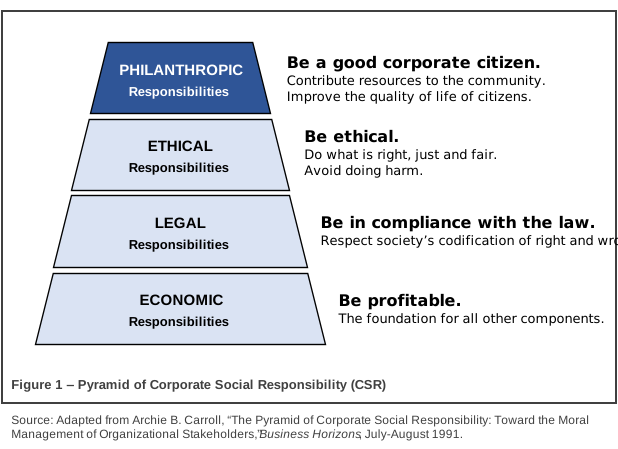
Philanthropic responsibility is about giving back, with a purpose to make the world a better place. It involves “charitable donations, community involvement, and voluntary actions that benefit society beyond what is legally or ethically required.”12 The caveat is giving back without expecting something in return, except for the recognition and benefits derived from doing good. In the words of Archie B. Carroll, “philanthropy encompasses those corporate actions that are in response to society’s expectation that businesses be good corporate citizens. This includes actively engaging in acts or programs to promote human welfare or goodwill.”13 According to Mr. Carroll, philanthropy is more discretionary or voluntary than all other CSR components, although society does expect that it will be provided. “In a sense, philanthropy is the icing on the cake” suggests Mr. Carroll.”14
From a Desirable Expectation to a Growing Necessity
In the age of information: company activities and reports, along with management attitudes and behaviors are scrutinized with a moral and ethical perspective. “Consumers increasingly vote with their wallets, employees weigh a company’s values when choosing where to work, and investors factor social responsibility into their decisions. As a result, how a company defines and practices CSR directly influences its reputation, growth, and long-term success.”15 Supply chain business partners also take notice. They will cut-off ties and run for cover when associated with an organization not perceived to be a good corporate citizen. Reputation is paramount.
The United Nations Educational, Scientific and Cultural Organization (UNESCO) states that “overall, CSR represents a shift from a narrow focus on short-term profits to a more holistic view of business responsibilities. When implemented thoughtfully, it can create shared value for companies and communities.”16 Companies that do not take their CSR responsibilities seriously are singled out, including those deceptively focused on public relations instead of meaningful actions, and those hypocritically misconstruing their actions (e.g. plotting business opportunities while giving).
Although CSR is clearly a business imperative, corporate volunteering is fueled by employees looking for connection, meaningful purpose, and opportunities to make a difference. “I believe the world is hungry for connection and purpose” says Abhishek Humbad, founder of Goodera.17 A survey of approximately 4,500 U.S. adults released in 2025, indicates that 74% of Americans are interested in “working to achieve a mutual goal that improves their community” although only 17% report having been able to achieve that goal during 2024.18 Based on the survey results, less than a quarter of those interested in volunteering are actually able to fulfill their aspiration.
The reasons why a majority of people are unable to volunteer nearly as much as they would like are explained by modern-day life challenges. Employees have busy schedules, work is demanding, pressures to perform are unwavering, family obligations are relentless, and childcare is costly. Social fragmentation, superficial friendships, excessive individualism, lack of belonging, and feelings of isolation and loneliness are also major contributing factors.19 The U.S. Surgeon General labelled loneliness an epidemic “associated with a greater risk of cardiovascular disease, dementia, stroke, depression, anxiety, and premature death.”20 Interestingly, a study on loneliness completed by the Harvard Graduate School of Education during 2024 indicates that 75% of respondents agree that “finding ways to help others” is important for reducing loneliness.21
Approaches for Meeting Volunteerism Aspirations
Insightful business leaders recognize the importance of meeting employee aspirations for volunteering, which is among the highest achievements of corporate social responsibility. Jessica Rodell, professor of management at the University of Geogia, explains basic volunteering approaches and how employees may be encouraged to participate. “In my research and consulting work, I’ve seen corporate volunteer programs of all shapes and sizes. Some firms allow employees to volunteer for whatever cause or activity they choose; others arrange highly structured outings that teams can participate in together – a charity run, for example, or a house-building effort. (…) Companies also differ in how they encourage, recognize, and reward employee volunteering efforts. (…) Companies should tailor their programs according to factors such as firm size, expectations of [key stakeholders], and cultural norms and characteristics” suggests Ms. Roddell.22
Since the new millennium, third-party organizations such as Goodera, Benevity, YourCause, Bonterra, Groundswell (and several others) offer volunteering services and platforms to support companies with employee volunteering programs. Services range from planning and managing corporate events, designing custom volunteering programs based on company objectives, and offering a suite of already established programs that outside employees can join. For instance, Goodera offers “thousands of corporate volunteering opportunities across cities worldwide, both virtual and in person, for individuals and teams alike. The causes range from education and health, to sustainability and local resilience [such as community gardening and green space improvements in urban areas].”23 Companies support employee volunteerism with flexible hours or paid time off.24 In some cases, employees may be seconded on a full-time basis for a period of time.
Substantial Benefits to Reap
Researchers from the Kelly School of Business, Indiana University, note that “many companies, including 90% of Fortune 500 companies, have employee volunteer programs that support and/or subsidize employee volunteer activities and community outreach on company time.”25 On company time, because the demands of modern-day life make it too difficult for employees to volunteer, leaving them frustrated and disillusioned from not being able to make the world a better place.
The researchers state that “volunteerism is an opportunity for firms to address the demands of stakeholders, contribute to the concerns and interests of communities, strengthen employee engagement, and encourage senior organizational leaders to embed socially responsible behavior within core businesses.”26 The opportunity generates substantial internal and external benefits (Figure 2). “Employee volunteerism as a practice of corporate social responsibility aids corporations by strengthening employee satisfaction and retention internally, and by strengthening corporate reputations and connections with stakeholders externally. (…) Employee volunteerism is what the best companies do and is good for business-inside and out” conclude the researchers.27
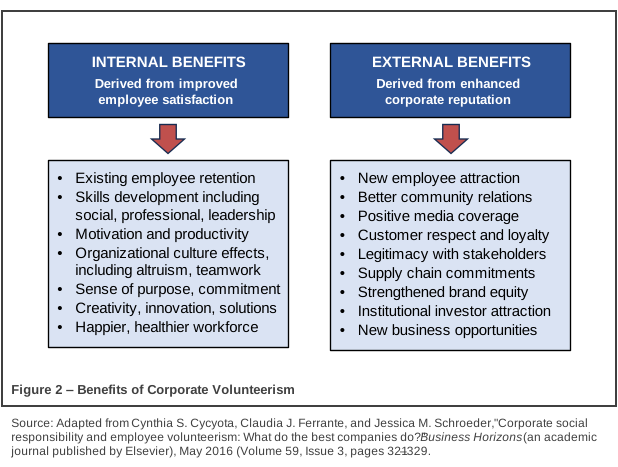
The effects of volunteerism and social responsibility on employee attraction and retention are significant. So are the potential negative impacts on corporate reputation and profitability. A survey of 1,800 millennials (people who are 30 to 45 years old in 2026), completed by public relations and marketing agencies, reveals that 61% of millennials “feel personally responsible for making a difference in the world” and 79% “want to work for employers who care about how they impact / contribute to society.”28 Moreover, 44% of millennials report they “would actively pursue working for a company after learning about their social commitment.”29 Conversely, 56% of millennials would “likely refuse to work” for a company that lacks social and environmental responsibility, and 45% would “likely refuse products or services” from such companies.30 In addition, 42% would “likely encourage family and friends to boycott products or services” from those companies.31
Corporate volunteering also has proven benefits for maintaining a healthy workforce. Research indicates that “volunteering can nurture both connection and, quite literally, healing. It is “well documented that acts of service trigger the release of dopamine, which improves mood and overall life satisfaction.”32 Research from the Carnegie Mellon University correlates that “older adults who volunteer for at least 200 hours per year decrease their risk of hypertension, or high blood pressure, by 40 percent.”33 The study suggests that volunteering may be an effective option to help prevent hypertension affecting 65 million Americans, a major contributor to cardiovascular disease which is the leading cause of death in the United States.34 The World Happiness Report of 2025, published by Gallup, reveals another very positive effect on wellbeing, namely a much lower propensity for depression among volunteers. “Deaths of despair are significantly lower in countries where more people report donating, volunteering, or helping strangers” states the Gallup report.35
Common Pitfalls to Avoid
The growing popularity of volunteering programs reveals a number of pitfalls that companies must avoid or carefully manage to ensure program success. Failure to avoid or effectively manage these pitfalls may even lead to such negative outcomes that the company might have been better off not to create or offer volunteering programs in the first place. These pitfalls mostly result from a lack of due diligence, and/or very poor judgment or immaturity on the part of company management. Examples of common pitfalls highlighted by researchers can be summarized as follows:
- Lack of authenticity – Some companies deceive stakeholders and the public at large, by exaggerating, falsifying or misrepresenting their involvement. In the context of CSR, such deceptive practices are commonly known as “greenwashing.”36 They include vague descriptions, unmet promises, inconsequential actions, lack of evidence, window-dressing, etc.
- Uninspiring programs – When designing programs, executives are often tempted to simply copy what other companies are doing, which may not align with their own company mission, vision, values, goals, objectives, etc. The disconnect may limit the intrinsic appeal to employees, and may not be perceived as positively as it otherwise could by external stakeholders.37
- Pet projects – Executives may design programs based on their personal charitable-giving preferences, or may continue the choices of their predecessors. Such programs reflect the personal values and priorities of senior management, which may not necessarily appeal to employees, who are the main contributors to corporate volunteering efforts.38
- Pressured volunteering – Program leaders often feel compelled to persuade as many employees as possible to participate. Although such behavior is generally well-intended, persistent pressure may create a perception that volunteering is expected and somewhat mandatory, leading to a loss of employee motivation and satisfaction.39
- Self-centered motives – When management only offers programs that directly align with company purpose and mission, the distinction between work and volunteering becomes blurry. Employees and other stakeholders will be highly critical and cynical of programs classified as charitable if such programs are not carried out for the right reasons.40
- Deficient managerial support – Some managers do not recognize the value of employee volunteering. They see volunteering as an excuse for not doing work. Unsupportive managers create a perception that volunteering programs are window-dressing, and that it is better not to participate. This situation results in employee cynicism and lower engagement.41
- Ineffective communications – Some companies are unclear about their program objectives, and their policies for supporting employees such as flexible work arrangements, time limits, expense reimbursement, etc. Another unclear policy issue relates to insurance coverage while volunteering, in regard to possible injuries, accidents or death outside the workplace.42
- Misaligned employee support – Employees do not necessarily have the same support needs when they volunteer. Employees who need to care for young children or elderly relatives do not require the same kind of support as those without family obligations. Support not properly aligned with employee needs results in lower participation and/or wasted resources.43
- Controversial situations – Some volunteering programs may be controversial from a political, social or religious perspective. Employees will react negatively if offered to volunteer for causes they object. Conversely, some employees may want to volunteer for causes that the company is not comfortable with. Scandals involving recipient organizations are another risk.44
Conclusion
Corporate volunteering is on the rise and going mainstream, because companies have come to realize the many benefits gained from supporting employee aspirations for volunteering. An Oxford University study suggests that volunteerism is the most impactful initiative for employee wellness, ahead of several other types of interventions. According to the study, “volunteering opportunities initially appear distinct from the other interventions, but are found to improve workers’ well-being through increased sense of purpose, accomplishment, social resources and recovery.”45
Simply put, volunteering makes employees happier. Their greater happiness leads to several workplace benefits, including improved employee retention, connection, motivation, commitment, productivity and creativity. Volunteering also builds corporate reputation and impresses upon job applicants, customers, suppliers, investors, the media, and the public at large. All of these benefits readily translate to better organizational performance, results and profitability. The research is credible and the benefits are tangible. Helping people do good ripples into the workplace, the community and beyond.46 As stated by Indiana University researchers, corporate volunteering is “what the best companies do and is good for business-inside and out.”47
However, designing and implementing corporate volunteering programs evidently “requires thoughtful planning and consideration. Companies should avoid taking the easy route to creating their volunteering initiative – such as mimicking others, focusing on pet projects, and forcing employees to engage. Instead, they should consider their company’s specific situation and strengths, capitalize on employees’ interests and engagement, and build the most meaningful volunteering opportunities possible.”48 Corporate volunteering programs also require “intentionality and personalization. Employees should have the opportunity to tailor their volunteer experiences to align with their passions rather than solely focusing on organizational goals.”49 When guided by true intentions, corporate volunteering programs create a competitive advantage.50
Endnotes
__________________________
1 Cynthia S. Cycyota, Claudia J. Ferrante, and Jessica M. Schroeder, Corporate social responsibility and employee volunteerism: What do the best companies do?, Kelley School of Business, Indiana University, (Elsevier, 2016).
2 Cynthia S. Cycyota, Claudia J. Ferrante, and Jessica M. Schroeder, Corporate social responsibility and employee (…).
3 Michael Sheldrick, “Corporate Volunteering Is On The Rise – Here’s Why That Matters Now” Forbes Magazine, Apr 30, 2025.
4 Michael Sheldrick, “Corporate Volunteering Is On The Rise – Here’s Why That Matters Now” Forbes Magazine, Apr 30, 2025.
5 Michael Sheldrick, “Corporate Volunteering Is On The Rise – Here’s Why That Matters Now” Forbes Magazine, Apr 30, 2025.
6 International Standards Organization, ISO 26000 Social Responsibility, November 2010.
7 United Nations Educational, Scientific and Cultural Organization (UNESCO), Website: https://www.unesco.org/en/dtc-finance-toolkit-factsheets/corporate-social-responsibility-csr (Accessed October 20, 2026).
8 Thomas Publishing Company, A Brief History of Corporate Social Responsibility (CSR), (October 24, 2023) Website: https://www.thomasnet.com/insights/history-of-corporate-social-responsibility/ (Accessed October 20, 2026).
9 Thomas Publishing Company, A Brief History of Corporate Social Responsibility (CSR), (…).
10 Thomas Publishing Company, A Brief History of Corporate Social Responsibility (CSR), (…).
11 Archie B. Carroll, “The Pyramid of Corporate Social Responsibility: Toward the Moral Management of Organizational Stakeholders” Business Horizons (July-August 1991).
12 United Nations Educational, Scientific and Cultural Organization (UNESCO), Corporate social responsibility, Digital Transformation Collaborative Financing Toolkit Factsheet, (2025), p.4.
13 Archie B. Carroll, “The Pyramid of Corporate Social Responsibility: Toward the Moral Management of Organizational (…).
14 Archie B. Carroll, “The Pyramid of Corporate Social Responsibility: Toward the Moral Management of Organizational (…).
15 Archie B. Carroll, “The Pyramid of Corporate Social Responsibility: Toward the Moral Management of Organizational (…).
16 United Nations Educational, Scientific and Cultural Organization (UNESCO), Corporate social responsibility (…), p.4.
17 Michael Sheldrick, “Corporate Volunteering Is On The Rise – Here’s Why That Matters Now” Forbes Magazine, Apr 30, 2025.
18 Calista Small, et. al., The Connection Opportunity, Insights for Bringing Americans Together, More in Common U.S. (Mar. 2025).
19 Michael Sheldrick, “Corporate Volunteering Is On The Rise – Here’s Why That Matters Now” Forbes Magazine, Apr 30, 2025.
20 Office of the United States Surgeon General, Our Epidemic of Loneliness and Isolation (2023), p.4.
21 Milena Batanova, et.al., “Loneliness in America: Just the Tip of the Iceberg?” Harvard Graduate School of Education, (2024).
22 Jessica Rodell, “Volunteer Programs That Employees Can Get Excited About” Harvard Business Review (Jan-Feb 2021).
23 Michael Sheldrick, “Corporate Volunteering Is On The Rise – Here’s Why That Matters Now” Forbes Magazine, Apr 30, 2025.
24 Amanda Shantz, Kiera Dempsey-Brench, “How Volunteerism Enhances Workplace Skills” MIT Sloan Management Review, (Apr. 28, 2021).
25 Cynthia S. Cycyota, Claudia J. Ferrante, and Jessica M. Schroeder, Corporate social responsibility and employee (…).
26 Cynthia S. Cycyota, Claudia J. Ferrante, and Jessica M. Schroeder, Corporate social responsibility and employee (…).
27 Cynthia S. Cycyota, Claudia J. Ferrante, and Jessica M. Schroeder, Corporate social responsibility and employee (…).
28 Cone Inc. in collaboration with AMP Agency, The 2006 Cone Millennial Cause Study, The Millennial Generation: Pro-Social and Empowered to Change the World, (Undated), p.6, p.17.
29 Cone Inc. in collaboration with AMP Agency, The 2006 Cone Millennial Cause Study (…), p.17.
30 Cone Inc. in collaboration with AMP Agency, The 2006 Cone Millennial Cause Study (…), p.9.
31 Cone Inc. in collaboration with AMP Agency, The 2006 Cone Millennial Cause Study (…), p.9.
32 Michael Sheldrick, “Corporate Volunteering Is On The Rise – Here’s Why That Matters Now” Forbes Magazine, Apr 30, 2025.
33 Carnegie Mellon University, Volunteering Reduces Risk of Hypertension In Older Adults, Carnegie Mellon Research Shows, (June 13, 2013).
34 Carnegie Mellon University, Volunteering Reduces Risk of Hypertension In Older Adults, Carnegie Mellon Research (…).
35 John F. Helliwell, et.al., World Happiness Report, Gallup, (2025), p.5.
36 United Nations Educational, Scientific and Cultural Organization (UNESCO), Corporate social responsibility (…), p.7.
37 Jessica Rodell, “Volunteer Programs That Employees Can Get Excited About” Harvard Business Review (Jan-Feb 2021).
38 Jessica Rodell, “Volunteer Programs That Employees Can Get Excited About” Harvard Business Review (Jan-Feb 2021).
39 Jessica Rodell, “Volunteer Programs That Employees Can Get Excited About” Harvard Business Review (Jan-Feb 2021).
40 Amanda Shantz and Kiera Dempsey-Brench, “How Volunteerism Enhances Workplace Skills” (…).
41 Amanda Shantz and Kiera Dempsey-Brench, “How Volunteerism Enhances Workplace Skills” (…).
42 Cynthia S. Cycyota, Claudia J. Ferrante, and Jessica M. Schroeder, Corporate social responsibility and employee (…).
43 Cynthia S. Cycyota, Claudia J. Ferrante, and Jessica M. Schroeder, Corporate social responsibility and employee (…).
44 Cynthia S. Cycyota, Claudia J. Ferrante, and Jessica M. Schroeder, Corporate social responsibility and employee (…).
45 William J. Fleming, “Employee well-being outcomes from individual-level mental health interventions: Cross-sectional evidence from the United Kingdom” Industrial Relations Journal, 55, 162-182, (2024), p.19.
46 Michael Sheldrick, “Corporate Volunteering Is On The Rise – Here’s Why That Matters Now” Forbes Magazine, Apr 30, 2025.
47 Cynthia S. Cycyota, Claudia J. Ferrante, and Jessica M. Schroeder, Corporate social responsibility and employee (…).
48 Jessica Rodell, “Volunteer Programs That Employees Can Get Excited About” Harvard Business Review (Jan-Feb 2021).
49 Julian Hayes, “Corporate Volunteering: An Untapped Competitive Advantage For CEOs” Forbes Magazine, Nov. 29, 2024.
50 Julian Hayes, “Corporate Volunteering: An Untapped Competitive Advantage For CEOs” Forbes Magazine, Nov. 29, 2024.